
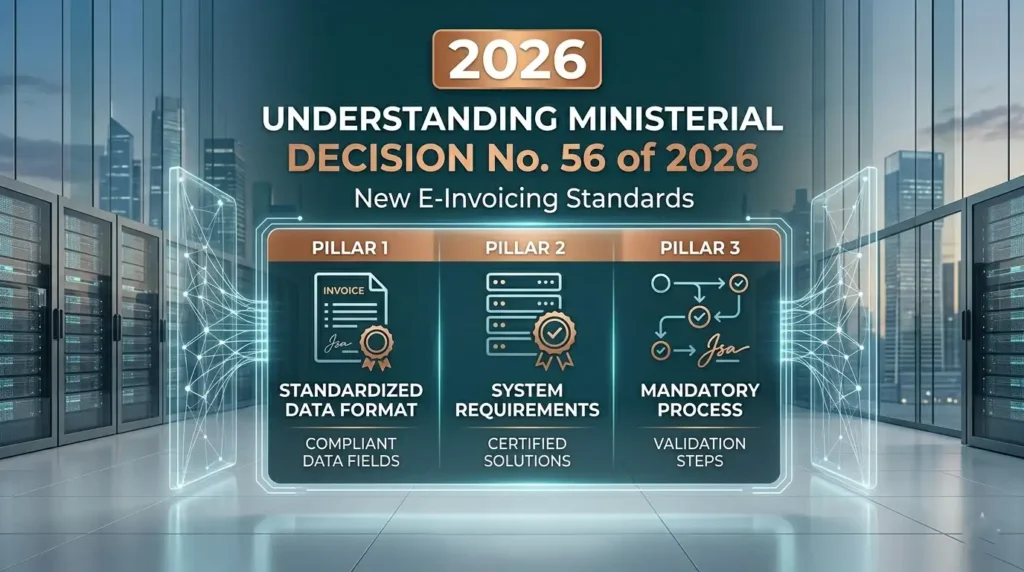
As the UAE accelerates its journey toward a fully digitized economy, the regulatory framework governing tax technology is becoming increasingly sophisticated. The Ministry of Finance recently released Ministerial Decision No. 56 of 2026, which amends the existing rules (Decision No. 64 of 2025) regarding the accreditation of E-Invoicing Service Providers.
For businesses in the UAE, this is a critical development. It defines the “gold standard” for the technology partners you will rely on to remain compliant with the Federal Tax Authority (FTA).
At The Capital Zone, we’ve analyzed the new decision to help you understand how these tightened standards protect your business and what you should look for in a service provider.
The Pivot to Global Standards: Peppol Integration
One of the most significant pillars of the new decision is the mandatory alignment with the Peppol (Pan-European Public Procurement On-Line) framework.
Under the updated Article 5, any Service Provider applying for accreditation must be an active Peppol-certified Service Provider. This means the software used must have successfully passed the OpenPeppol conformance tests.
Why this matters for your business:
By adopting the Peppol standard, the UAE is ensuring that e-invoices are interoperable. This means your digital invoices will be compatible not just locally, but with international business partners, reducing friction in cross-border trade and ensuring your data is transmitted via a secure, standardized network.
The “2-Year Rule”: Proving Operational Maturity
The new Article 5(bis) introduces a strict experience requirement to ensure that only stable, proven technologies enter the UAE market.
- The Threshold: The E-Invoicing product (PSP Product) must have been in operation for a minimum of two years.
- The Evidence: Providers must submit supporting documentation to the Ministry to prove this track record.
This change is designed to prevent “start-up glitches” in the national tax infrastructure. By requiring a two-year history, the Ministry is ensuring that the platforms handling your sensitive financial data have a proven record of security and reliability.
Outsourcing vs. Responsibility: A Clear Boundary
Article 5, Clause 2, addresses a common practice in the tech world: white-labeling and outsourcing. The law now explicitly allows Service Providers to utilize third-party products or outsource the management of their invoicing services.
However, there is a strict accountability clause:
The Service Provider retains full responsibility for meeting all accreditation conditions and for the oversight of the services provided.
For business owners, this provides a layer of legal protection. Even if your provider uses a sub-contractor for their server management or software development, your primary provider remains legally liable for any compliance failures or data breaches.
The 8 Pillars of a Qualified Service Provider
To be accredited in the UAE in 2026, a Service Provider must now meet eight specific criteria:
- Peppol Certification: Global interoperability.
- Verified Experience: At least 2 years of product operation.
- Company Registration: Legal standing within the UAE.
- Service Adherence: Compliance with Ministry-specific service levels.
- Tax Registration: The provider itself must be in good standing with the FTA.
- Information Security: Robust protection against data leaks and cyber threats.
- Self-Declaration: Formal commitment to all regulatory standards.
- Insurance: Mandatory coverage to protect against professional liabilities.
Strategic Impact: What Should You Do Now?
If your business is currently evaluating E-Invoicing solutions or preparing for the next phase of the UAE’s digital tax rollout, your checklist has changed.
- Audit Your Current Provider: Ask your current accounting or IT provider if they are Peppol-certified and if their product meets the 2-year operational requirement.
- Review Liability Clauses: Ensure your contracts reflect the provider’s “full responsibility” as outlined in the 2026 Decision.
- Prepare for Seamless Integration: The move toward Peppol-certified providers means that switching systems in the future will be easier, as your data will be in a globally recognized format.
Leading the Way in Compliance
Ministerial Decision No. 56 of 2026 is a welcome update that brings clarity and security to the UAE’s tax technology sector. It ensures that the digital tools businesses use are not just compliant, but world-class.
At The Capital Zone, we stay at the forefront of these legislative shifts so you don’t have to. Navigating the intersection of tax law, company formation, and digital compliance is our specialty. We help you choose the right structures and the right partners to ensure your business thrives in the UAE’s digital future.
Need help navigating the new E-Invoicing requirements?
Contact The Capital Zone today for a Strategic Compliance Consultation.
Disclaimer: This blog provides a summary of Ministerial Decision No. 56 of 2026 for informational purposes and does not constitute legal or financial advice. Consult with our qualified professionals for specific compliance requirements.